Showing posts sorted by relevance for query hypertoons. Sort by date Show all posts

Friday, May 22, 2009

Hypertoons from CSN

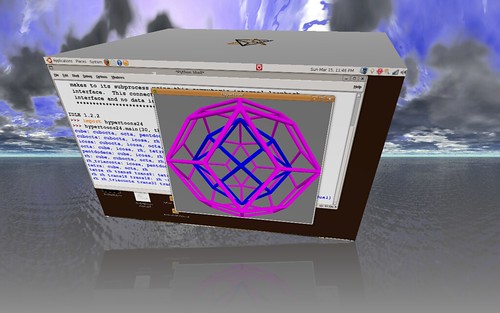
If you're not averse to having an LCD running some ambient geometry in the background as a way to jump start your brand, we have some FOSS for ya, but you'll need a geek or two to install it and boot it up, or maybe you're a geek yourself. I'll write as if you were...

Grab and install VPython
from Carnegie-Mellon or one of those, then grab my hypertoons generator, deposited at 4Dsolutions (we're like your memory bank of cool toyz).

If you want a podcast to preview, Synergetics on the Web has an example (narrated), or check YouTube for more.

Hypertoons are looping animation tracks with a network structure, such that you'll segue differently based on Python's pseudo-random number generator.

A hyper-audio track (matching or on its own) would be a logical next feature, feel free to start a project pointing back to its root. This isn't a visualizer, so don't worry about infringement (not a screen saver either -- wouldn't matter if it were).

You'll maybe be able to make your own hypertoons eventually, but for starters this starkly geometric one serves a didactic purpose (teaches philosophy), is family friendly -- is even interactive if your setup allows for controls.

You'll need some way to run Python. Maybe slave an XO to a ceiling mounted computer projector and shoot against some opposite wall?

I've not tried this particular option, am not sure if Vpython runs on an XO-1, plus why waste a perfectly good laptop for such a primitive purpose? Some junker with a gig of RAM oughta do the trick. Free Geek has those by the boat load (thx!).

Note: there's a stereo option but you'll need the special "glasses".

Sunday, May 27, 2012

Hypertoonery


Le Hypertoon is classically conceived of as an animation consisting of segues twixt a set of key frames.  It's not like you, as a viewer, necessarily know which frames are key, however over time this may become more clear, as some of the vistas are definitely deja vu.

Depending on the design, key frames my show up less than once a minute (one can imagine really long loops) or many times a second, though that's reaching a threshold for even short attention spans.

In the rarified world of pure geometry hypertoons, which may act as a kernel, anchoring a broader sampling of STEM topics, we have the concentric hierarchy hypertoon, somewhat signature within CSN as a part of its decor, blends well with a McMenamins style, an influence on your first CMO (moi).

Imagine tetrahedrons, variously sized, and spinning.  They glom together in certain ways.  Turns out they have interesting capabilities, to assemble one another.

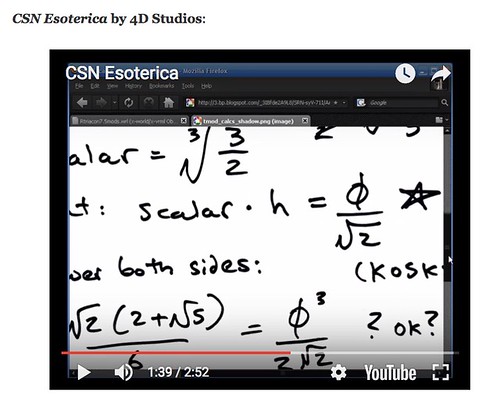
Koski's U, V and W all build one another using phi-scaled versions of themselves.   They make a spiral.  They make the fat and thin hexahedrons of quasi-crystalline fame.  The U may be considered 2 K modules in volume where 1 K = 1 T module scaled by 1.5 i.e. K + K = T + T + T = A + A + B = 1 Mite in volume.

A self-referential pool like this will take you to high speed geometric hypertoons at various singularities.  Then the show will slow down again.

A nice jungle scene with parrots, some foreground discussion of the ecosystem's feedback loops, with cutaways to animations.  Humans have done a lot of homework here, but without doing permanent damage.  We feel happier every time that happens.

Note that there's nothing to say a hypertoon can't use live action, in the sense of adding physics rules. Classic hypertoons are based in pure geometry because the makes the key frame connections reversible whereas documentary footage tends to run best one way (not always).

My Python prototypes compute their frames on the fly allowing for real time interactivity, with the user spinning and zooming as the action unfolds.  Higher resolution hypertoons or "reveries" might be pre-rendered and streamed by a kind of player / reader that doesn't need to recompute.

Hybrids use a combination, say a computed foreground against a pre-rendered background.  This gets us into game territory pretty quickly.

Back to Koski modeles, some equations from the Poly list, in lightly edited form:

I use this method for differentiation of the various sizes of phi-scaled tetrahedron:

. . . U6, U3,
U, u3, u6 . . .

since volume changes by phi to the 3rd, 6th, 9th power when linearly scaling by up phi.
U3 > U (U=u) > u3 and so on.

The U,V, W tetrahedra are composed of these amounts of lessor sized U, V, W:


U = (2)w3 + (5)u6 + (4)v6 + (2)w6

V = (2)v3 + (3)u3 + (1)w3

W = (2)w3 + (3)v3 + (1)u3

The Fat rhombohedron  =
(18)W + (6)u3 + (6)v3 + (6)w3

The Thin rhombohedron =
(6)W + (12)u3 + (6)v3 + (6)w3

Thanks

Dave


Sunday, June 30, 2024

Hypertoons vs Dreamcasts


I don't know that these dreamcasts are really called that; I was just looking for a word. Are they the hypertoons I've been describing, i.e. smooth transformations between keyframes in a network? They could be. Hybrids are doable, by simply adding repetition and branching.

More to the point is attention to a specific corpus. My paradigm hypertoons, the corpus I've personally explored, is that of one "concentric hierarchy" i.e. a nest or maze of polyhedrons. I've elsewhere suggested "a cabal" of polyhedrons (or how about "bouquet"?). The Synergetics namespace is already self-consciously intra-corpus transformative in a right brainish animated way.

Rather than surrender to the stochastic randomness of generative graphics, we could use AI to make some of the segments, but then loop in other segments developed by other means. Children's Television Workshop has always been a model: come up with canonical representations of A-Z, 0-100, and have the segments segue through those. An AI fantasy about the letter A turns to a claymation. These might be among the art school's warm-up exercises, with benefits to children.

For example, we want the Jitterbug, treated over and over by different graphical artists. Once at an icosahedron, we have so many ways to go. It might become a nucleocapsid. It might unfold into a world map. The icosahedron might take its place in a flextegrity lattice, underwater, with fish. 

Sunday, February 16, 2020

Hypertoons Again (Autobio)


Hypertoon treatment would be ideal for communicating Synergetics, because of the partially overlapping scenarios configuration.

A hypertoon is like a spaghetti ball of short cartoons (animations) terminating in switch points where smooth segues (transitions) may occur.

Synergetics suggests lots of animated sequences, such as an octahedron turing into a "boat" and spiralling forward or backward ("arcing").  Does this scenario serve any useful scientific purpose?  As a Platonist, I'm just following the tetrahelix thread.

Another transformation is of course the Jitterbug, at the center of the Concentric Hierarchy as a unifying "bow tie Universe" pulsation device (one could say).  Telling the story of the Jitterbug and its "station stops" is traversing a kind of backbone, from which many side stories branch out.

In more recent autobiographical videos I talk about a Pycon in Washington, DC where I was scheduled to talk more about hypertoons. I actually did get to give such a talk, at a different Pycon in DC, if memory serves. Dawn joined me on that trip. When was that?

Thursday, May 20, 2010

Non-Commercial Use


I was alerted to the above video by John Driscoll today, as we met at Lyrik. We discussed the Sesame Street model as an inspiration for hypertoons, long-running reveries that explore a database of video clips, stitching them together in real time, and/or asynchronously.

Programmers may need to (or wish to) insert local content, interrupting a feed from some distant source. The Shop's caretakers having mixing powers i.e. editing responsibilities. What's going on in the neighborhood? Curious customers want to know.

CSN is not about surrendering local control to some imperial center.

Given this blog is "prefrequency" in the sense that we're sketching an open source business model, providing the prior art, I'm OK with showcasing "non-commercial use" segments.

When syndicating for the CSN network itself, compensating artists will not be a verboten concept, even though we're a philanthropic organization, a charity, a worthy cause ourselves.

As the chief marketing officer (CMO), I'm not opposed to being rewarded for my architecture (new circuit designs for motherboard Earth), nor for my hypertoons concept. My thanks to Richard Hawkins for early encouragement along these lines (I entered a contest to win a Sun workstation, didn't win).

Dr. Nick has been educating me about the work of Mark Lakeland, local activist. The intersection known as Sunnyside Piazza is due for repairs. City Repair has scheduled an event for May 29th. This intersection is not far from Duke's Landing. Expect some photographs.

Friday, February 2, 2024

Computer Generated Hypertoons

Hypertoon in VPython

I'm always wondering what a production house with some serious animators could make from my primitive "hypertoon" concept.

The idea is a simple one: think of a smooth transformation between A and B, nevermind yet what exactly is transforming. Label A and B as "key frames". Now imagine scenarios A to C and B to C. We now have a triangle. A point D with scenarios to A, B, C would now complete a tetrahedron.

A "scenario" could be like a cuboctahedron (A) twist-contracting into an icosahedron (B) ala the Jitterbug Transformation. That icosahedron (A) could then spin around 31 axes (opposite corners, mid-edges, face centers) yielding a great circle network (C). The network (C) could then shift, with some circles staying, others forming, others fading, to give the 25 great circles of the cuboctahedron (D). Add A to D. D to B might involve some kind of global sharing.

The hypertoon "playhead" displays scenarios between key frames. When it gets to a key frame, a decision is made, perhaps randomly, perhaps weighted, and a next scenario gets played. There's a sense of smooth transformations throughout, as the viewer visually tours the "space" of interconnecting scenarios. The network might be compared to a spaghetti ball.

Key frames that link to themselves, i.e. that start and end on the same frame, might sometimes run a number of times in a loop.

Search on "hypertoons" in the search box at the upper left for more, including some running examples.


Thursday, November 3, 2016

Self Contained LCDs

Looking for Memes

The idea of a self-contained LCD stems from having display system and programs in a single unit.

Perhaps a Raspberry Pi or similar GPU-endowed motherboard is tucked away internally within some cabinet, along with the display screen it feeds.

Mount the assembly and plug it in, and it boots into a set repertoire of animations, perhaps with sounds.

Yes, our sign could be little more than a billboard with rotating advertising.  As such, this technology is already out there, next to freeways, at Times Square.

In the CSN context, we use our screens to share reveries, perhaps hypertoons, continuous transformations scanned from a network of scenarios (edges) interconnecting the key frames (nodes).

One such hypertoon might feature the assembly and disassembly of well- and lesser-known polyhedrons from phi-scalable tetrahedrons.  The topic is purely abstract, yet precise.

The rhombic triacontahedron (RT) dissects into 120 such modules, left and right handed.

Meanwhile, the regular tetrahedron may be sliced into four quadrants, each of which further subdivides into three pairs of left and right handed versions of the same shape, for a total of 24 modules, differently shaped from the ones above.

Those of us schooled in American transcendentalism have our own vocabulary for these geometric concepts, making it easier for our engineers to communicate with one another.  The RT dissects into E-modules, the regular tetrahedron into A-modules.

The E-shape resized to match the A-shape in volume is the T-module.  You will find all the plane-nets in transcendentalist works but don't expect too much from your literature profs.  Readers in the humanities tend to eschew what appears to be purely technical, even if it's also architectural.  We don't get many polymaths like Hugh Kenner.

Said rhombic triacontahedron, in which two Platonics are inscribed, relates to the rest of the Platonic Five though the Jitterbug Transformation.  The icosahedron and cuboctahedron connect in this way, bridging the two symmetry families (five-fold with four).

When David Koski was through Portland lately, we had a CSN meeting at #CodeCastle, the Sunnyside Methodist Church turned community center.  Some of us had visited PDX Code Guild the night before.

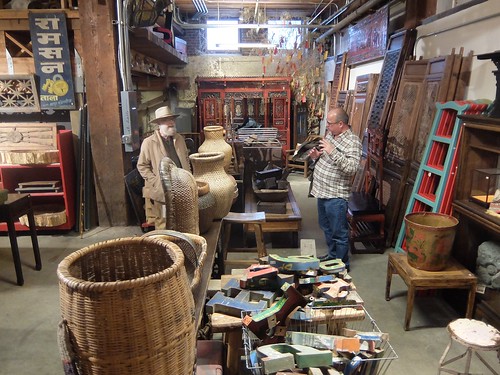
Thanks to our already sharing a lot of the same memes, as a subculture, CSN is well-positioned to move the "coffee shop LCD" to a next level, as an art form.  We've been touring many East-meets-West retail outlets for inspiration.

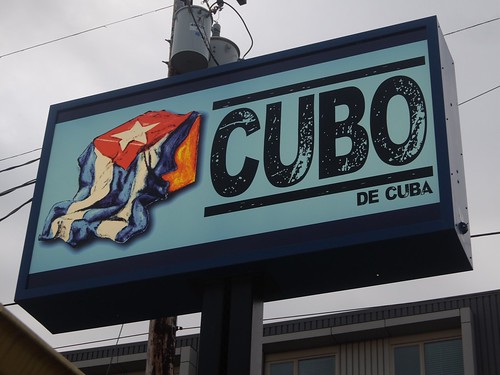
Will we have some CSN LCDs in Havana, Cuba, in time for SciPy next year?  All the hypertoons I've prototyped in actual computer code have used Python.

Cubo Cuba... Cubs!

Wednesday, April 1, 2020

Hypertoons on 3DTV


I've usually shared hypertoon reveries as a flat screen experience, as if on an HDTV.  You'll find an earlier blog post on LCD aesthetics.  However we need not confine our imaginations to such prosaic devices.  Won't 3DTV be here soon?

When you imagine a pixelated surface, do you think of squares or hexagons?  We can tell a lot about your personality based on that, just kidding.  As when tiling a bathroom floor, we have our reasons for going with one or another tiling pattern.

Space comes with "tiling" patterns too.  Instead of pixels, we have voxels?

When you imagine a voxelated volume, do you think of cubes or rhombic dodecahedrons?  I'd say a majority will think of cubes and don't know much about that other thingamajiggy.

However rhombic dodecahedrons are more neighborly in the sense of sharing more faces.  Cubes share six faces with neighbors (why we call them hexahedra).  Dodecahedrons (of this space-filling voxel kind) share twelve.


As soon as you start filling space with some repeated shape, you're likely to think "honeycomb" or even "lattice" whereas an engineer might think "space frame".  Different professions teach different words, but we all know what it means to "brick a volume" with some shape, even if said shape has all diamond faces.

The sculptors at Flextegrity Labs, the informal name for your builders' skunkworks, know all about modeling sculptures in 3D, given C6XTY and its progenitors came from a 3D imagination in the first place, via CAD and industrial processing.

Having the CCP (another name for our lattice, not a political party) pre-implemented in software, with each icosahedron or ball position selectively illumined, is a kind of 3DTV in its own right.

The sculpture supports its own weight.

We don't need to wait, to experiment with sound and light shows.  Our gallery was in the nightclub district, after all.

Who knows, perhaps 3D hypertoons could be in our future?

Or shall we say 4D, switching to the Bucky brand, wherein the Tetrahedron anchors our sense of "dimension" in a four directional volume, our "space"?  We've learned that "namespaces" coexist and that an either/or mindset may be unnecessary in the long run.

So sure, 4D it is.  Too.


Saturday, February 9, 2019

Refugee Science


Some of the first charitable gaming salons may be discovered among refugee populations, eager to help their own cause and causes like them.

I've been writing some on Refugee Science on Medium. No hypertoons on refugee camps yet, which doesn't mean we have none in the network (or the pipeline).

Stay tuned.

Monday, February 8, 2010

Future Projections

I've been going over use cases with a pro in the business, former owner of the Venetian Theater in downtown Albany. The profit margin on coffee shops is extremely thin, especially if you subtract adult consumables such as mixed drinks, which most shops do not offer.

The budget for start ups will have to be for advertising, with the vendor beneficiaries winning the good will sweepstakes, for having taken some initiative. The games will be family friendly and we probably will not have those adult beverages, except maybe in the usual segregated areas, more like Spaghetti Factory in some ways. YMMV. Depends on zip code quite a bit.

What's on the LCDs is what matters most to some of the stakeholders, and we expect to find alcoves, diversity in tastes. Not everyone is studying the same topics or cares about the same things. Geometry cartoons featuring classic polyhedra, no matter for what product (if any), have their own cultish following. The NFL has another, partially overlapping fan base.

From the sound of it, one might expect universities to jump in, say the MIT student union. Screens showing hypertoons have that geeky aesthetic one would not be surprised to encounter, if wandering Cambridge or Woodstock (near Reed).

I have also suggested a military lineage, in that some mission-accomplished watercraft, equipped with great kitchens, might retire as tourist attractions in a next chapter, while prototyping whatever kind of philanthropic engine the management has seen fit to test out.

Some aircraft might go this route as well. Serving people in their seats, without leaving the ground -- the model for many a restaurant. Some who fear flying, might get used to it this way.

Decisions do not bottleneck through me praise Allah, except in the few venues where a management team might include me. Like with Visa, there's no uber-boss, plus I'm mostly just wearing a marketing hat (CMO is my title).

The sharpness of HDTV is something else to think about. They change the atmosphere considerably.

By this time one may have asked whether religious establishments might use this same infrastructure.

Many a monastery had and/or has a vendor aspect. By contributing jam, beer, honey, cheese or whatever goods to the local economy, in barter for wine, exotic beans (or whatever other provisions not obtainable through tended fields), a religious establishment was creating a market niche for itself, creating one or more brands.

This mixing of temple and commercial trade is/was not frowned upon in principle, across multiple branches (denominations) so long as the products remained benign and prayerfully considered (incense... special remedies). Putting any surplus into wise disbursements, as a result of concentration and study, is what religious academicians do as well as non-religious, however self-labeling.

The community service nonprofit (or NGO) is a close relative of the religious establishment, another arm for social service. Many lawmakers would rather have government not compete with more private players, whereas others see too much privacy as a source of abuse. Either way, one could see where a philanthropic institution might partake of this status.

In an effort to reach customers where these customers want to be (at sports bars for example), these market leaders will need to test working prototypes, fine tune. We already have many examples (e.g. BackSpace and CubeSpace). The payoff will be getting into the game early, in an adjacent space (close to sports bars in some ways, yet different).

My Cult of Athena memes were meant to guide an aesthetic. The Oracle of Delphi escaped Apollo, meaning these are relaxed venues, not too spartan. Read back in the archives if curious. This is a philosophy blog, is not just about business.

Monday, August 11, 2025

College Prep Synergetics


If you're a long time reader of this blog, which features Philosophy Talk, then you'll likely be familiar with:

(a) hypertoons and
(b) 4D vs 4D vs 4D

The former has to do with computer animation, or actually any kind of moving picture, where the "playhead" is free to wander around amidst a network of scenarios, with seamless segues at keyframes.

The latter has to do with natural language, our awareness of "language games" within semantic space, either invented for investigatory purposes, or teased out of ordinary language itself. Wittgenstein. What language games involve "4D" as a meme?

These themes add together in our genre of science fiction, labeled Martian Math for marketing reasons, but not necessarily all that oriented towards Martian lore. ETs and science fiction more generally enter the picture, as we unfold our specific 4D mathematics.

Monday, October 21, 2024

Hypertoon City

Given I'm back in the wheelhouse, steering a cohort through rites of passage in the cult of coding (Python) and stats (statistics, data science), I'm once again reintroducing the tools of the trade, such as pandas and numpy. And the datasets in seaborn. Such as tips, penguins and titanic.

Thinking about tips gave me a prompt for the above AI graphic, but in my head I was imagining a tips-based hypertoon. Imagine a black and white (meaning grayscale) film in which 1950s dressed urban characters frequent a busy restaurant. 

Consider a camera shot of one table with five people, two smoking, three dressed as males. In one scenario, a woman gets up, espying a good friend at another table. She begs pardon from her table mates, saying she'll be right back, and she takes an empty seat at a nearby table, striking up a conversation with her friend. 

The camera is following all these and sees her return. We might even see a cut, letting viewers know time has passed, but not much.

In the diagram, that would be like an arrow from a circle, looping back into itself. She gets up, the action takes us away from the table, but we come back, almost as if nothing had happened, and indeed, lets have at least a few frames that never change. 

This immutable segment, of people sitting just so, with just these expressions, is what we keep coming back to, which adds a dimension of eerie dreaminess to this film. This isn't the only keyframe we keep revisiting; it's one hub among many. We in a looping environment such that we'll eventually have seen every scenario, but there might be hundreds of them, of varying length.

The general idea is you have keyframe immutable sequences from all over the restaurant, including outside on the snowy sidewalk, in the restrooms, where women gossip and men stare stoically at urinal advertisements, in the kitchen, in the back alley with the dumpsters. 

Then you have a playhead, which travels within the spaghetti ball of scenarios that interconnect all these keyframes in a graph, a network, a topology. We might have five scenarios that take us to the dumpsters, and three that take us back inside. Each scenario has a direction, an arrow marking time's flow. In geometry hypertoons, these scenario transformations might all be reversible, but when it comes to humans in a restaurant, most action is one-way.

Here's the random element: when the movie player, the playhead, enters a keyframe sequence, it has more than one way to go next. The viewer will recognize the table, the people, but last time she got up, whereas this time she doesn't. A waitress shows up instead. 

Next time a waiter appears, whom this time we follow back into the kitchen (and there's that same chef -- we keep seeing him, and those pancakes...). We don't get back to that table for quite awhile, revisiting other tables, and those dumpsters again, before we get there. We end up following that lady back, like the first time, from the table she'd been visiting. It's exactly the same scenario. We're on rails. 

You get the idea.

Wednesday, April 8, 2020

Koski's Kiosk


Koski's Kiosk is great alliteration and will go forward in the literature, website or no.

Perhaps a synonym for "module" in the "tetrahedral wedge" sense, could be "kiosk". A tetrahedral voxel within a family consisting of family members E&T, S, A&B. Or these could be subway lines.

At the stations, the Kiosks appear as actual newstands with "read all about it" headlines regarding the Koski Identities. 

Picturing like Japanese anime, hypertoons with chill beats.

Monday, September 13, 2010

Subscriber Channels

The edupunk movement uses open source course / curriculum materials as raw input to make these hacked, value added, channel streams.

I'm on the lookup for a channel suitable for such as Laughing Horse Books (and video collective): Obey Giant type material is part of the mixins (ala Shepard Fairey), plus recycling posters for past and upcoming music events.

A channel needs a good VJ sometimes, someone to break in with allusions and timely reminders. We're not just running what was stuffed in a can for this time slot, days or weeks back, even though many clips are golden oldie. The mix gets remixed.

I'm not against auto-mixing algorithms as some readers know though. The hypertoons archive comes with segue / bridge nodes organized by connecting-edge scenarios. These partially overlapping animations and/or live action streams of consciousness have a seamless quality, especially if tightly crafted to organize a namespace / reality, such as Uru. Geometry lends itself to teaching by hypertoon, as does Geography (a specific terrain).

My sources tend towards cartoon, some circus material. This relates to the carnival atmosphere of the original geekdom. There's also the underground comix aspect, the idea of superheros, goddesses, archetypal beings. Geography + Geometry. There's also the Martian Math angle, mixed with RBF's bluer lagoon (more Polynesian, with lots of dolphins and mermaids).

Perusing an Art Book
:: js inspects art book near Remote, Oregon::

Sunday, October 14, 2018

Key Frame: Prying Apart

csn_esoterica

Sometimes this blog is about "reveries" for showing on CSN LCDs.  As you sip your coffee, you might want to let your gaze wander from LCD to LCD.  Some will be showing abstract patterns, geometric information.  That's the kind of thing described here.

"Prying Apart", a World Game Museum exhibit, refers to appreciating a small gap in radius between two otherwise identical shapes.  One is a tad smaller, leaving a gap.  We're talking polyhedrons here.

RT = Rhombic Triacontahedron.  That's the zonohedron in question.

Subsequent key frames, to which smoothly transforming scenarios might exist, would be such as:
  • "Remember the MITE (and Rite), Aristotle was Right" (space-filling tetrahedra)
  • 2nd and 3rd roots and powers including "surd" symbol: √
  • the golden ratio: Φ
  • Fee, Fie, Foe, Fum (four submodules of the E module)
  • the power rule (relating linear to areal to volumetric growth)
  • two spheres (and a thin wall between them)
  • a pair of RTs (tiny difference in radius, volumes 5 & 5+)
  • an RT of volume 7.5 sharing vertexes with the RD of volume 6
  • an RT of ~21.21 embedding the Jitterbug icosahedron (as long diagonals)
  • five concentric zonohedra (six counting the cube of volume 3)...
  • one of which is the the space-filling RD of volume 6
  • the concept of tetravolumes
  • T & E modules (RT)
  • A & B modules (RD)
  • alternative powering models
  • scaling by Φ
In other words, we might envision one degree of separation between "minding the gap" (same thing, another alias) and key frames with any of the above labels.  Between key frames:  tweening frames.

For those new to this blog, here is where marketing sometimes storyboards "reveries" (LCD screen animations in many cases) for streaming.  Some of these are "hypertoons".

RT5 radius: 0.999483332262343440046
SuperRT:   21.213203435596425732025
5+ RT:      5.007758031332838515933
5  RT:      5.000000000000000000000
Emod:       0.041731316927773654299
Tmod:       0.041666666666666666667

Friday, October 16, 2020

Hanging By a Thread


The "hypertoons" we yak about in this blog have their roots in reveries around the Concentric Hierarchy of Polyhedrons, which includes:
  • nesting them
  • spinning them
  • folding and unfolding them
  • Jitterbug Transformation
  • turning inside-out
  • chirality
... and so on.

Happy Halloween (it's getting close).

Sunday, November 4, 2018

Another Reverie


Not one of my hypertoons, but in a somewhat similar style and covering some of the same concepts.

Queue for the LCDs?

Every coffee shop is different.  The "design science" clientele expects to be reminded of these memes.

Thursday, January 2, 2020

Undersea Scans with C6XTY

Undersea Lattice

With the close of Lattice Gallery, right behind Pacific Northwest College of Art (PNCA), came the end of Phase I:  public awareness.  The press release to the Sculptors Conference net us a key audience, and a footprint in Art World at last.

However, Phase II is likely to focus on marine biology in some dimension, with neutral buoyancy sensors held in stasis by slender "stalks" per the famous Lanahan Flextegrity design -- what Lattice Gallery was all about.  Marine Habitats.  Ecotourism.  What's down there?

How do we address CCP lattice balls uniquely?  Why not use coordinate addresses.  The stalks have sufficient diameter to carry insulated cable.  We don't have to use 5G or even 4G, thereby interfering with signal.  We'll have an underwater matrix able to sense schools of fish, unaffected by the cabling, and render them in 3D in real time.

Some of you may be imagining a much more spaced-out matrix with room for larger objects, pre-programmed to dodge nodes (hubs) and stalks (connectors).

Better yet, we're free to communicate on public frequencies, i.e. use WiFi so 5G or 4G might be just the ticket.

The underwater buoy matrix, in CCP conformation, will depend on C6XTY-like buckyballs (macro-sized) holding their own positions.  This might require battery power only for the duration of the tournament or other sporting event.  Think of drones, but underwater.

Have you seen our technical journaling about (a,b,c,0) addressing for these pods?  Popular mechanical engineering themes weave through this (x,y,z) fabric of lattice elements.  Do we call it Cartesian?  Our high schoolers start to study these topics well before students in most states (of mind). Would you like to accelerate along a learning curve?

I'm looking to India and other ancient cultures for some feedback on this question, regarding the IVM as an archetype.  What's the etymology of "isotropic" in ancient Greek?  Do we find the IVM in the Vedas in some precursor form?  Some Buddhist have said it means Void (in translation).  That sounds fine, but let's not wait for someone in California to figure it all out, OK?  Oregon Curriculum Network has more direct sources.

IVM has many meanings of course, as my PhD friend Dr. Potkin reminds me.  Of course this being CSN, home of those synergetics hypertoons, I'm using the namespace of Dr. Fuller:  isotropic vector matrix.

That's the CCP (or FCC) to you chem heads (Linus Pauling's preferred stomping ground).  Check OCN's stash of Jupyter Notebooks for more info (School of Tomorrow meme).


Downtown Portland