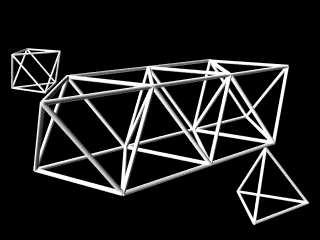
Note that if I build an XYZ skyscraper and an IVM space station side by side, there's no implied scale factor until we start adding the little human construction workers and/or cosmonauts or whatever. The XYZ and IVM scaffoldings each float free of one another in the imagination with no necessary strategy for entangling them. Creating a conversion constant required a designer's touch, as there was no one right answer to mathematically deduce, nor any empirical answer for scientists to uncover.
What's revolutionary about a tetrahedron unit is not its size relative to the XYZ system, but its shape. The tetrahedron stabilizes the cube and provides an ecosystem in which both have an integer volume, versus only the cube when it's allowed to hog the limelight. The tetrahedron is simpler, topologically, and stronger, structurally. Making it also be unit is a streamlining maneuver that XYZers get awkward about, forgetting to walk their own talk i.e. different axiomatic underpinnings were never verboten nor even defended against. We welcome this example of an alternative paradigm.
Fuller figured out a way to bring a cube and tetrahedron within 6% of each other by making XYZ edge 1 be a CCP ball radius, and making IVM prime vector (tetra edge) be edge 2, i.e. twice XYZ's. The unifying concept, like the cosmonauts above, is the unit radius CCP ball. Make its radius define the XYZ unit cube and make its diameter give the edges of the IVM unit tetrahedron.
It's a simple story, linking the two scaffolding strategies, the skyscraper and the space station skeletons.
One may also introduce the TetraBook at this point, the one triangular page book, with triangular covers open wide open flat. The page wages back and forth in an arc.
When the page is vertical to the covers, the two right tetrahedrons described, symmetric around this vertical partition, are each equal to that of a cube of edges R, shown in green down below. That's XYZ's unit cube, in the background. In this IVM world (call it Mars), we're modeling the unit cube's volume as a right tetrahedron of all edges D, except for the "hypotenuse" which is even longer.
Tilt the page a little further, either way, and you get a regular tetrahedron and its equal-volumed complement. That's the unit of volume in the IVM system, shown below in blue.