Wednesday, October 24, 2018

The Economics (and Psychology) of Philanthropy

Fresh Baked

The way most people think of philanthropy is you first need to amass a fortune, like Dale Carnegie did, or Bill Gates.  Then you get to use that fortune to influence the future in a major way, through various foundations.  The rest of us get to be on the receiving end, begging for patrons.

However, since the rise of electronic money (I'm including cryptocurrencies) and the ability to transact at the nickle and dime level (small amounts), it's become a lot easier for you and I, people without vast fortunes, to be philanthropists.  We may go on Patreon and support Youtube channels.  We see the results:  more programming of a kind we favor.

The Coffee Shops Network is about extending this ecosystem through the use of computer games.  You might not see the reasoning for putting a barrier between a would be donor and a programming channel.  Why can't I just give them the money?  Well of course you can.  Winning the computer game, or scoring high, lets you give others' money, that's the difference.

Who's money?

Consider a biscuit company that hopes you will buy their biscuits.  If you do, you get a token to play the game.  If you score high enough, you get to allocate an amount to charity, from a fund the biscuit company has set aside.  If the game is too difficult, people won't play.  If the game is too easy, the fund will be drained to quickly.  However, with this many parameters to play with, fine tuning occurs and before long, the biscuit company is happy with the increased sales.

A respectable company sets aside money for charity anyway.  In classical Economics, that was called Good Will in the chart of accounts, either explicitly, or perhaps it was measured as such, when writing up the financial statements and prospectus.  Investors like to see their investments going to companies with a conscience.

One of the main benefits accruing to you, the player, is you're free to publish your track record.  Not only may others get some idea of your skill level, they get to see what charities you consider worthy.  Not everyone has as much time or talent for research.  You may attract imitators.  You may attract fans.  You're a hero after all.

Part of what a Coffee Shop does is provide an environment for comparing notes, for doing research in the first place.

What will be the psychological effects of having children think about giving charitable donations from an early age?  What will be the effect on adults?  We don't have all the answers yet.
Children Self Schooling

Sunday, October 14, 2018

Key Frame: Prying Apart

csn_esoterica

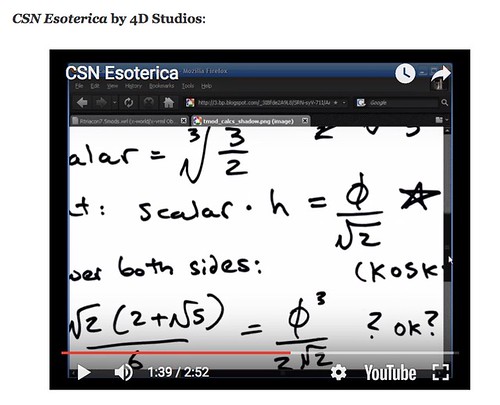
Sometimes this blog is about "reveries" for showing on CSN LCDs.  As you sip your coffee, you might want to let your gaze wander from LCD to LCD.  Some will be showing abstract patterns, geometric information.  That's the kind of thing described here.

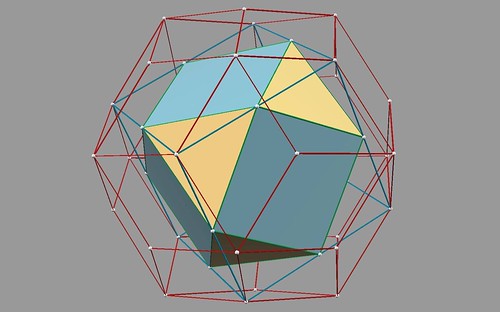
"Prying Apart", a World Game Museum exhibit, refers to appreciating a small gap in radius between two otherwise identical shapes.  One is a tad smaller, leaving a gap.  We're talking polyhedrons here.

RT = Rhombic Triacontahedron.  That's the zonohedron in question.

Subsequent key frames, to which smoothly transforming scenarios might exist, would be such as:
  • "Remember the MITE (and Rite), Aristotle was Right" (space-filling tetrahedra)
  • 2nd and 3rd roots and powers including "surd" symbol: √
  • the golden ratio: Φ
  • Fee, Fie, Foe, Fum (four submodules of the E module)
  • the power rule (relating linear to areal to volumetric growth)
  • two spheres (and a thin wall between them)
  • a pair of RTs (tiny difference in radius, volumes 5 & 5+)
  • an RT of volume 7.5 sharing vertexes with the RD of volume 6
  • an RT of ~21.21 embedding the Jitterbug icosahedron (as long diagonals)
  • five concentric zonohedra (six counting the cube of volume 3)...
  • one of which is the the space-filling RD of volume 6
  • the concept of tetravolumes
  • T & E modules (RT)
  • A & B modules (RD)
  • alternative powering models
  • scaling by Φ
In other words, we might envision one degree of separation between "minding the gap" (same thing, another alias) and key frames with any of the above labels.  Between key frames:  tweening frames.

For those new to this blog, here is where marketing sometimes storyboards "reveries" (LCD screen animations in many cases) for streaming.  Some of these are "hypertoons".

RT5 radius: 0.999483332262343440046
SuperRT:   21.213203435596425732025
5+ RT:      5.007758031332838515933
5  RT:      5.000000000000000000000
Emod:       0.041731316927773654299
Tmod:       0.041666666666666666667

Tuesday, September 11, 2018

Boosting Python (the computer language)

Making Math

No, I have not to date joined the PSF trademark committee.  Kirby here, __CMO__ (Chief Marketing Officer) for CSN, where the double-underline aesthetic mimics Python's "special names". Imitation: the sincerest form of flattery, right?

So yes, that's an example of me "boosting Python" i.e. casting about for mnemonic techniques that might help cement the language in one's thinking.  "Python fits your brain" (sells itself) to begin with in this regard, so I don't have the uphill battle some in the language arts might face.

I've also looked at where Python already has a niche in western hemispheric lore, now spread to the world thanks to Disney.  Apollo and Athena, both Greek deities (superheros) stood for different value systems, as did (does) Dionysus. A lot of English and German language lit explored the Apollonian versus Dionysian spectrum, leaving Athena to her own devices.

athena_python

However, in ancient Greek lore, Apollo goes after the Python under Mt. Parnassus, the residence for the Delphi Oracles, which originally worshipped Athena.  Their oracular powers somehow derived from the Python.

We might see Apollo's aggression as an act of hostile takeover.  We might let the snake get away from him in some versions, a fork I explore in my "escaped to Nashville" meme.

We all know Athena's mascots or familiars include both Python and Nike. Her statue in Nashville's Parthenon reminds us of these facts.

Here in Portland, Oregon, I live not far from the Nike headquarters of "Just Do It" fame (one of its advertising slogans), so why not consciously imitate with a "Just Use It" for Python? 

I've used that myself in some ASCII art output "on the farm" (we use Tractor and Field objects).

apollo_vs_python

Wednesday, July 11, 2018

CSN Marketing

Hexapent

The Coffee Shops Network is about paying you to be good at computer games.  Maybe that sounds like heaven to some people, or an impossible utopia, but hear me out:  it has always been that way, we've just had changing meanings for "computer" and "games" and "good" (also "paying").

You're rewarded for making computations that work out.  Great, so now we're talking like tautology.

Being good at computer games means you're good with your winnings.  You have fans following how you spend your credits, on your own reputation sure, by giving to causes.  We pay in you "pass through" money:  it's for charity, but you get to decide which ones, in proportion to your exercise of good judgement.  What you get paid for.  Back to tautologies again.

In a typical casino, the winner walks out with the cash and presumably buys flashy cars, cuff links, mink stoles, perfumes, other luxury items.  However, given the dire need for serious engineers and engineering, those making money that way don't get as much long term support, nor do politicians.

People want institutions they might believe in, and in winning computer games, get an opportunity to show their support for same.  Other players watch and learn.

A typical arcade game is an anonymous affair.  You may claim a high score, but probably won't have the necessary bona fides.  Formal sports are another matter.  Everyone knows the score.  A Coffee Shop may host a variety of games, however some of them may require that various records be kept, including the player's identity, especially where giving credit is concerned.

Monday, November 6, 2017

Hypertoons 2017

CO in RT

Synergetics has taken various twists and turns since the 1970s, when Macmillan came out with the second volume, designed to interleave with the first, and including an index. In that second volume, we got a more complete basis for working with the five-fold symmetric shapes already within the concentric hierarchy, namely the T, E and S modules.

Picking up on that thread, we have since amplified the 120 T-module volume 5 rhombic triacontahedron, of radius just a tad under 1 (0.99948...), to another copy weighing in at 7.5 and sharing a set of tips with the rhombic dodecahedron (RD), of volume 6.

The 120 E-module volume 5+ RT, on the other hand, of radius precisely 1, scales up by Φ (linearly) to give the 15√2 volumed RT, dubbed SuperRT, wherein the Jitterbug Icosahedron of edges 2R, embeds as long diagonals, with a volume of 5√2 Φ2.

The ratio of said Jitterbug Icosahedron to its related larger-volumed cuboctahedron (CO) of equal edges is defined by what David Koski and I are calling the S-factor i.e. CO/Icosa = S/E = (2√2)/Φ2  or (2√2)Φ-2 or about 1.080363.

Starting with any Icosahedron, one application of the S-factor nets the volume of the corresponding CO with same edge lengths, the "Jitterbug" relationship.

Two applications of 1/S-factor (the reciprocal), on the other hand, nets the volume of the corresponding CO with faces flush to the same containing octahedron, the "skew" relationship.

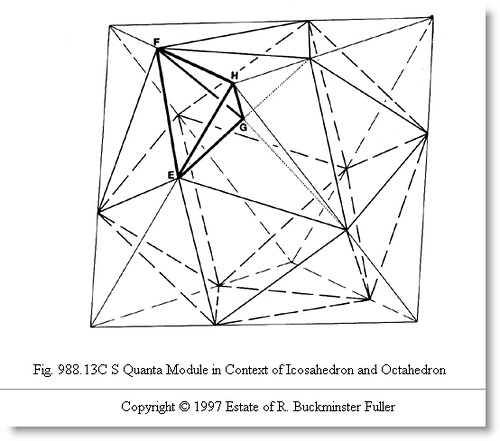
In other words, this smaller-volumed CO and Icosa are skew to one another with overlapping facial regions, as shown in Synergetics 2, Figure 988.00.

For example, the Icosahedron inscribed in the Octahedron of volume 4 has S-factor edges.  Two applications of 1/S-factor gives the volume 2.5 CO with edges R, i.e. precisely 1/8th the volume of the 2R 20 volumed JT CO.

CO2.5 * S-factor * S-factor gives the S-factor-edged Icosa inscribed in the volume 4 octa, from whence S-modules are derived.

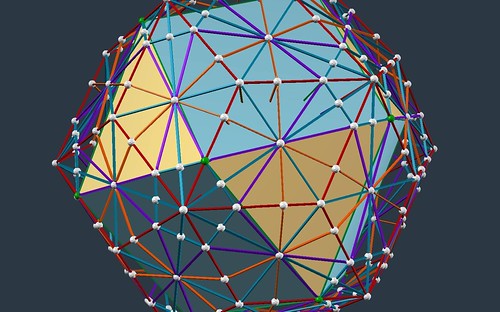
One more application of the S-factor gives the CO shown below, nestled precisely within the RT5+ at the green points.

In contrast, the CO with √2 edges, shown above is precisely 1/3rd the RT5+ volume.

Finally, David realized another relationship:  S3, the volumetric version of the Synergetics Constant, ordinarily used to take us from cubic units to tetrahedron units, is also the ratio of SuperRT to the Jitterbug CO. S3 = √(9/8).

Put another way, the RT with long diagonals equal to the Icosahedron from which a CO is developed by Jitterbugging, has a volume S3 times that CO's volume.  20 * S3 = 15√2.

We may also introduce the T-factor as the ratio between the RT5+ and RT5, i.e. the E-modules and T-modules rhombic triacontahedrons.  That number is (3√2)/Φ3 or (3√2)Φ-3. The reciprocal of its 3rd root is the linear scale factor 0.99948... (mentioned above) taking us from the E-mods RT to the T-mods RT.


S-Factor Radius

Saturday, June 17, 2017

Koski Paper

Original 2015 paper by David Koski:


[ note typo:  "It has a volume of 5(√2)ø2 = 18.52295." should read "18.512296...". ]

What's an S module?

The canonical octahedron of volume 4 has inscribed within it, faces flush, an icosahedron of smaller volume.

Their volumetric difference, carved into 24 modules, four meeting at each octahedron vertex, comprise the S modules, 12 the mirror image of the other 12.

The S mod's volume is (φ **-5)/2 relative to unit volume tetrahedron of edges equal those of the canonical octahedron.
S Module

What's an E module?

Take the Rhombic Triacontahedron (RT) that precisely shrink-wraps a sphere (as does the Rhombic Dodecahedron of volume six), and you will find that in tetravolumes it slightly outweighs the RT of volume precisely 5, with 0.9994... the radius.  Explode this 5+ volume RT into 120 wedges and you'll have your E modules, left and right.  The slightly smaller RT of volume 5 is made from T modules.


Following David's paper, we scale S and E modules up and down, by the golden ratio.

I use the convention that lowercase means "scale down" as in "shrink" and capitalized means "scale up" as in "expand".

Since to scale edges by a linear factor (in this case φ) is to change volume by a 3rd power of that factor, the numbers 3, 6, 9... are used to indicate by how much volume has changed up or down i.e. by φ**3, φ**6 or by φ-3, φ-6.

Examples:
smod6 means Smod * (φ**-6)
Smod6 means Smod * (φ ** 6)

In the Python code below, we're confirming that the concentric hierarchy volumes of the tetrahedron, cube, octahedron, icosahedron, may be expressed in lowest term sums of S and E modules of mix scale.

Related Python code (hit the run button to compute output, appears at bottom):

Sunday, April 16, 2017

Factory Girl (movie review)


Andy Warhol fans and detractors already know this story. I was only glancingly familiar with most of his work until recently, when Portland Art Museum unveiled a major retrospective.  That helped me tune in more of his scene, though I didn't catch the name Edie Sedgwick until last night, when I finally saw the dramatization.

My thoughts flashed to Patty Hearst a few times, and her relationship with her own family. I'm not a know-it-all on these families, just we have a lot of windows and telling remarks in the public record, which facilitates discussion of celebrities.  Orson Welles comes to mind.

Edie was an heiress from a Santa Barbara ranch family, transplants from Boston, East Coasters on the Pacific. Hearst Castle is on the same coast.  When I think of Hearst, I often flash on Homer Davenport, his lead political cartoonist in some chapters, and native of Silverton, Oregon.  I have quite a bit about Homer in my blogs owing to my friendship with Gus Frederick, an expert on Homer's life and to some extent times.

Edie big dream was to find herself in New York and to pioneer a freer way of being alive in a city big enough hearted to support such experiments.  She was by all accounts bold, but in falling victim to drug abuse, got derailed.  This was the story of a generation and has not ceased being the core plot of many scenarios.

Folks in my cohort have their own generational window in that I was old enough to have Warhol on my radar, but not adult enough to track the soap operas.  I uncover the history of my own time in my later years, having lived through it in my own day dreamy way, as some kid in Italy or whatever.

A lot of work went into making this a real telling. The filmmakers undertake their task seriously. I'm reminded of Mishima.  In being a dramatization, the script takes many liberties with the facts, many of which remain unknown. This movie is but one possible assembly of an intricate jigsaw puzzle.