Sunday, July 24, 2016

Rotten Apple Award


Tuesday, June 21, 2016

The Tesseract, the Time Machine and the Tetrahedron

Campfire

My title above is reminiscent of The Lion, the Witch and the Wardrobe, at least in terms of mentioning three rather disparate things.  That's intentional.  Welcome to Narnia, chuckle.

This campfire story, suitable for children, is about many great minds and how they grappled with their intuitions in different ways, coming up with different games, yet with overlapping memes, such as "dimension" and even "four dimensional".

We associate a Time Machine with H.G. Wells, who also wrote War of the Worlds, but also with Dr. Who I suppose, as what's that Tardis if not an inter-dimensional phone booth?  Milo had his Phantom Tollbooth with similar powers to transport.  If only Gulliver could have had one, to escape the Lilliputians.

However lets talk about Regular Polytopes and their rather gentrified neighborhood, in the sense of rectlinear, properly grided, with its main axial boulevards all meeting at right angles, as many as we need.  The upstanding L, as in perpendicular, rules in this multi-dimensional kingdom, of XYZ on steroids.  Abbott's Flatland helps us get comfortable with our higher dimensional mental powers.

Then Einstein came along with novel propositions about the relativity of simultaneity and therefore causation (as in "who made whom do what"), based on a new kind of dependency, that of one's own coordinate system.  One's point of view determined one's narrative more than we knew, even in physics.  Where you stand depends on where you sit.  Your angle on the action is therefore not "negligible" (nor off the table as a matter for peer review).

Linear independence in the Euclidean sense of XYZ was no longer sufficient, as no one God's Eye  coordinate system (interpreted by His duly appointed minions) could deny the others their physics, and yet these others might nevertheless tell the story in different ways, with different villains and heroes.  Blasphemy!

Logic was not forcing a unique or unitary result, and this seemed threatening to some, especially imperialists. Non-Euclidean geometry seemed subversive (Einstein was Jewish).  However the mathematicians were reassuring:  "we always promised as many rose gardens as you can manage" they said, "given the right fertilizing axioms."

Just the right set of axioms (no pun intended) or game rules, will fuel a fire that burns well, a game that plays.  Some won't become eternal favorites, whereas others may sit on a shelf pending rediscovery by players of matching mindset.  The time capsule effect.  Sleepers awaken.

Finally: the Tetrahedron, and a third chapter in our wandering story.

The primacy of the rectilinear orthodoxy was further called into question.  Why should right angles be so consequential at the end of the day?  They're unavoidable, true, but should they be that definitive?

On Planet Earth, two perpendiculars to the surface are not parallel to one another.  The smaller one is, relative to the planet, the less difference that makes.  But humans had outgrown their flat earth fixations by 1999.  What if the IVM tetrahedron played as well or better with others vis-a-vis the XYZ cube?

Well it turns out we have a choice of flavors.  Either / or is out the window (more a fallacy than a contradiction).  Enjoy them all, and more besides!

Really, I'm just retelling the story of 4D vs. 4D vs. 4D ("three scoops"), which is about three ways in which this 4D meme survived a 20th Century shakeout.  Different generalists commanded each namespace, keeping each coherent enough to avoid flaming out.

The polytope-minded gentry, many of them French, circled their n-dimensional wagons to protect their geometry from what they saw as time-degraded physics, the savage realm of Energy and Entropy.  Euclidean geometry is pre-Newtonian in its aloofness to temporal matters, almost Platonic in its relationships.

The Tetrahedron, meanwhile, wove back and forth somewhere in between, not needing a fourth perpendicular necessarily, for its additional degrees of freedom, yet sympathetic to the timelessness of Euclid and Plato.  The concentric arrangements of Platonics and their progeny was "pre-frequency" until some "frequency" was applied, giving spatiotemporal, special-case meaning.

Yes, this story is a deliberate simplification, as the "dimension" concept is slipperier than a slippery fish.  We have fractional dimensions today, perhaps even irrationally fractional (like pi).  The levels of indeterminacy and interdependency have also increased, with the discovery of quantum entanglement.

But hey, this was enough to get us going, and off to bed, to dream of swimming memes.

Visit your local science museum or library, for more information on the Tesseract (4D hypercube), the Time Machine (piloted by Einstein), and the Tetrahedron (4D in a different sense, just count the arrow tips).

Monday, June 20, 2016

Donate to CSN

[QR-code removed]

As a part of the #CodeCastle cryto-currencies initiative, it makes sense to walk the talk by both sending and receiving bitcoin as an authorized means of upholding one's end of a transaction.

I suggest making only small and non-anonymous donations if using the above QR-code for that. Claim the donation with your own public bitcoin address either just for that purpose or use your general wallet PK.

Do not assume anyone verifies these claims on our end, however the blockchain is public so there will be no doubt about the transaction itself, after some hours, and many donors are well-equipped to authenticate themselves in case their claim is contested.

Do not assume your donation is tax deductible, which is another reason to keep to small amounts. Contributions to a specific nonprofit's fund account would be through a different QR-Code.

The above is to CSN's marketing for CSN's promotion, an account controlled by the CMO (Chief Marketing Officer).  Feel free to earmark though, and to publicize your thinking on CSN in connection with your history of donations.

Come back to this web page for the best QR-code to use.  You can keep a snapshot of what it was at the time to verify your own blockchain transactions.

Sunday, June 12, 2016

HP4E Update

 :: link for more discussion ::

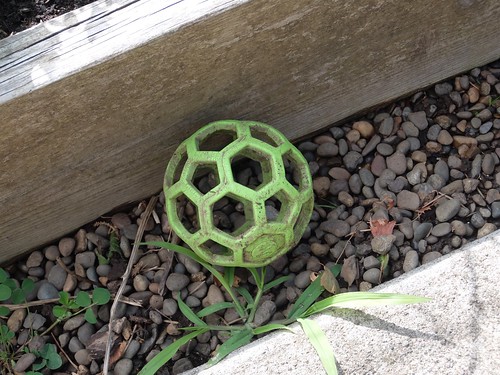
A decade ago, I started a media campaign known as HexaPents for Everyone or HP4E.  The Hexapent is another name for a BuckyBall or Fullerene.  The former, Bf, or C60 is the soccer ball topology, however more fullerenes of higher frequency (more hexagons) are conceivable.  There's a C72 and so on.

The gamer community is where HP4E took off, with or without my campaign.  Hexagons have long been a feature of two-dimensional game boards.

Seen from a gods-eye point of view, the player hovers over a plane of hexagons, moving assets around, building or destroying a civilization, as the case may be.

Many gamers realized that, given the Earth is spherical, there was maybe a way to have the hexagonal tiling close back on itself in all circumferential directions.  Those who explored the most deeply discovered the twelve pentagons needed for this closure to occur.

Proposals were floated on the Internet suggesting that Civilization itself, a popular commercial game, adopt this hexapent format.

The HP4E memeplex likewise has become a part of various global models of a more scientific bent, as carving the Earth into tetrahedral wedges, of which the hexagons and pentagons are composed, makes for a cellular data structure subject to various algorithmic techniques.

The mapping giants, Google Earth and ESRI, have offered somewhat muted support for hexapent displays.

DSCF6376

The commercial mapping world is still fixated on spherical trapezoids, which become more square towards the equator.  These are no more equi-angular or equi-area than the hexagons and pentagons, but lat / long is what we're used to.

Fortunately, given the power of computer algorithms, it's not an either / or relationship and the hexapent matrix has a bright future even in the commercial sector (my prediction).

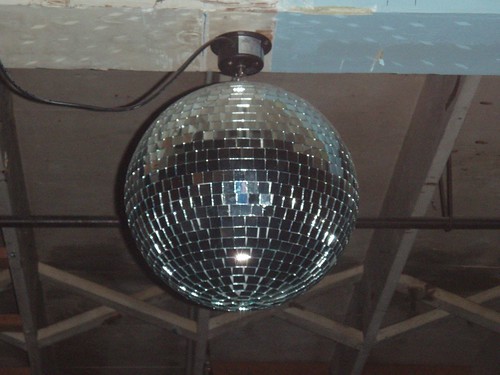
Finally, I've long been waiting for the crystal ball, also known as the "disco ball", to come out in hexapent form.

With CAD and laser cutters, getting the mirrors to be hexagons and pentagons, or even triangles, is not impossible.  A new brand could establish itself almost overnight.  I scan the Web for adverts.

Disco Ball

Monday, June 6, 2016

NeuroToon


Is is still called anthropomorphism, even when they're not human?

Saturday, May 21, 2016

Future Math

Multiplicative Identity

DSCF5747

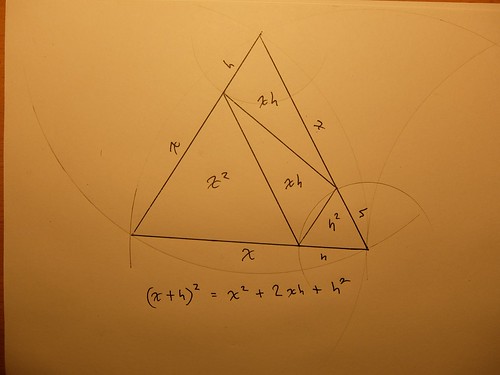
I drew this to help Andrius, in Vilnius, visualize an important identity, used in calculus.  Going to the next higher power, using a tetrahedron, would be a logical next step.

Princeton is where I ran into Wittgenstein's philosophy, including his Remarks on the Foundations of Mathematics (RFM).  When Ludwig wants to "investigate" a math concept, or any concept, he'll often construct "language games" for that purpose.

He does this with intent, as a sketch artist would, to bring forward specific aspects of play that might have been confusing.  Language gets to be a tangled mess sometimes.  For Wittgenstein, philosophy was a lot about disentangling.

Speaking of disentangling, a theme of my writings has been to separate three meanings of 4D.  For example, check out this blog post regarding 4D vs 4D vs 4D.

I'm seeing the 1900s as a period of "shake out" wherein three principal meanings of 4D settled down, each comfortable in its own groove.  They're not identical and to confuse them is to become entangled in a web of language.

Coxeter.4D is what we call "extended Euclidean geometry" meaning (x, y) addressing of R x R (a plane), and (x, y, z) addressing of R x R x R (volume), is extended to any number of real number lines or dimensions.  Regular Polytopes, by Donald Coxeter, is a major contribution within this lineage.

Einstein.4D introduces time as a space-like dimension in that one's perception of time and motion is a function of one's reference frame relative to others, such that those moving at closer to the speed of light age less quickly than clocks at rest.  What's the same across inertial coordinate systems is a space-time interval in which (x, y, z, t) figure in to the computation as four inputs (hence 4D).

Fuller.4D focuses on the primacy of the tetrahedron in the Kantian sense of introducing concepts we cannot shake, such as "enclosure" (container) along with "concavity" (in the cave) and "convexity" (outside the container).  We're born with the a priori idea of being "in" something and the tetrahedron is a topologically minimal concept of having an inside.

Donald Coxeter himself was at pains to disambiguate between his extended Euclidean 4D and Einstein's relativity theory's 4D.

We might summarize this difference as "the difference between a tesseract (hypercube) and a time machine", on the understanding this is precisely the difference some science fiction writers may deliberately confuse, as a plot-driving device.

Donald writes, on page 119 of Regular Polytopes:
Little, if anything, is gained by representing the fourth Euclidean dimension as time. In fact, this idea, so attractively developed by H.G. Wells in The Time Machine, has led such authors as J. W. Dunne (An Experiment with Time) into a serious misconception of the theory of Relativity. Minkowski's geometry of space-time is not Euclidean, and consequently has no connection with the present investigation.  (Dover Publications, 1973)
Donald's relationship with Fuller, another spinner of 4D, was somewhat inevitable in hindsight, and might be characterized as "stormy at first, smoothing out into friendship".

A first point of contention was around intellectual property, around radomes in particular.  The US military honored a US patent in contracting with Fuller's firms for DEW line radomes, situated in Canada.

Donald's son, a Canadian, was hoping to break in to the radar dome business and came up against not owning the relevant patent.  Donald went ballistic, thinking such a fundamental geometry of nature would really have to be open source.

Fuller's having patented the octet truss, in addition to the geodesic dome, likely didn't improve matters.  Both are found all over the place in naturally occurring physical objects.

The softening in their relationship came with the Montreal Expo '67 geodesic dome, a marvel to behold and huge.  Coxeter eventually agreed to let Fuller dedicate Synergetics to him.  Synergetics is where Fuller's use of 4D is made clear.  Bucky writes:
527.702 Geometers and "schooled" people speak of length, breadth, and height as constituting a hierarchy of three independent dimensional states --"one-dimensional," "two-dimensional," and "three-dimensional" -- which can be conjoined like building blocks. But length, breadth, and height simply do not exist independently of one another nor independently of all the inherent characteristics of all systems and of all systems' inherent complex of interrelationships with Scenario Universe.
...
527.712 All conceptual consideration is inherently four-dimensional. Thus the primitive is a priori four-dimensional, being always comprised of the four planes of reference of the tetrahedron. There can never be any less than four primitive dimensions. Any one of the stars or point-to-able "points" is a system-ultratunable, tunable, or infratunable but inherently four-dimensional.
Coxeter was also impressed by Fuller's discovery of the cuboctahedron number sequence, 1, 12, 42, 92, 162 and so on, his formula for generating this sequence, and generalizable to other shapes.  Clearly Fuller was doing his own thinking to some high degree.

In computer science we now have the concept of "namespace" which is equivalent to the humanities notion of "context".  For example in Python a namespace may be a module, saved in storage as a Python script.

The meaning given to the various names in a script will become evident at runtime.  Likewise in the humanities we appreciate that authors have their own unique ways of using certain words, which both borrow from and contribute to shared usage patterns.

Disentangling the meanings of 4D is important to future math, and to one's level of cultural literacy.  Our Coffee Shops Network has the LCD reveries that help boost one's understanding of these many nuances and subtleties.

by Hollister (Hop) David
(with attribution to me)

Monday, May 16, 2016

Business Model in Bitcoin

DSCF5442

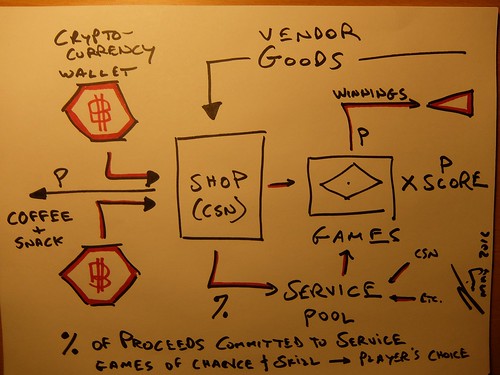
Although suggestive of Bitcoin in particular, the CSN model operates with any currency, crypto or not.

Customers of the Coffee Shop buy vended goods (e.g. snacks + coffee), with a percentage of the sale price committing to a Service Pool, which the vendor tallies as after-profit charitable contributions or Good Will (a legit line item in most charts of accounts).

Customers have the option to multiply winnings, drawing from the Service Pool, with said winnings committed to the service organization (or Cause) of the player's choice.  The shop is doubling as a center for engaging in philanthropic behaviors.

Not shown in this diagram:  the customer's option to add victories (donations) to a profile (chronology).  What better way to advertise one's values?  Show a track record of philanthropic giving, thanks to CSN infrastructure.

Other posts spell out more details as to how pooled Good Will might aggregate faster than payout in some phases, slower in others.  Imagine aggregate player ability as a variable, like collective IQ.  Would we want to re-normalize the games i.e. make them harder or easier, to control payout?   Changing the rules punishes those specializing in mastering a given sport.  Changing the payout is easier, though one may argue devaluing a game's relative payout is a change in the rules.

You'll likely notice that Casinos which do feature skill aspects to some games, face similar queries, which is why CSN is sometimes branded a casino chain, even with proceeds going to worthy causes other than self in most transactions, and not "the house" either, as the customers get to earmark and profile accordingly.

CSN shops (nodes) do have some control over the menu however i.e. the range of worthy causes to which winners may commit their winnings.  Customers are free to shop around and/or play from home so shop constraints are not that onerous, merely reflective of a shop's own profile (a way of branding).