Monday, May 16, 2016

4D Meme

Constructing Volume
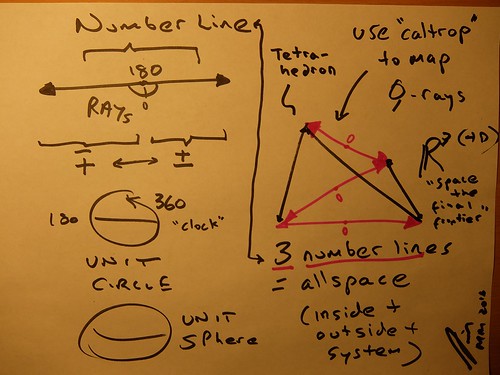
Fig 1: three number lines

If three number lines are place tip-to-tip in a zig-zag (non-coplanar), a half-tetrahedron (pink) will be defined, complemented by the other half (black).

zig_zags
Fig 2: three-vector zig-zags
from Fig 110A of Synergetics

Picture the three number lines (each made of two rays), starting as line segments, then growing or subdividing without limit.

These same three number lines, made mutually orthogonal, define the origin (0,0,0) in XYZ.  These number lines likewise extend without limit to define volume or all-space.

Given six number-line edges define volume (3 + 3), we may say space is 3D.  The pink zig-zag of three segments might even feature two right angular turns.  The set {(1,0,0),(0,1,0),(0,0,1)} is cast as the basis set for spanning this space.  Every point is reachable by (x i, y j, z k) where x,y,z are Real numbers.

Alternatively, we may highlight the four vertexes and faces of the full tetrahedron and define res extensa as inherently 4D (self-evident fourness), with quadrays (caltrop coordinates) emanating in four directions from origin (0,0,0,0) and spanning space in linear combinations, no negating operation required.
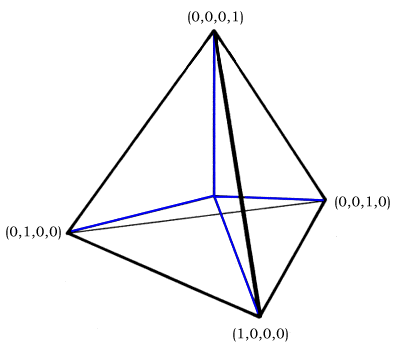
 
Fig 3: Q-rays

In Fig. 1, R3 is shown as a "4D" tetrahedron (pink and black). In Fig. 3, the four basis vectors (1,0,0,0), (0,1,0,0), (0,0,1,0), (0,0,0,1) with scalar multiplication by non-negative numbers are sufficient to span R3 through linear combinations.

Although we may consider space 4D, given the iconic stature of the tetrahedron, upon subdividing the edges to show growth by subdivision, we obtain a 3rd power sequence relative to the frequency of the edges.  3rd powering is likewise illustrated with a tetrahedron.

Powering Meme
Fig 4
Fig. 4: 3rd Powering
from Fig. 990.01 in Synergetics

In the shoptalk of XYZ, we say R3 is 3D.  However, the all-positive basis vectors remain helpless to reach 7/8ths of space without the operation of negation -- flipping 180 degrees -- an operation provided by scalar multiplication in conventional linear algebra, and providing the additional -i, -j, -k of the familiar "jack" pattern.

In the shoptalk of Synergetics, we say the IVM is 4D, given the self-evident fourness of the tetrahedron, yet without denying 1:2:3 power aspect of linear : areal : volumetric growth.  The four all-positive basis vectors do not require the flipping operation of negation (by definition rotation) to span all-space, only vector scaling and vector addition.
Wednesday, April 20, 2016

Quadray Coordinates

Traditional XYZ vectors:

A lot of what I'm writing here applies to teaching (x,y,z) vectors of the ordinary kind. 

Given six vectors: {(1,0,0), (-1,0,0), (0,1,0), (0,-1,0), (0,0,1), (0,0,-1)} we're able to reach any point in RxRxR (volume) as addressed by (x,y,z) using:

(A)  the operation of addition (V + V -> V, V a vector)
(B)  the operation of scaling (s * V -> V, s a scalar)

(A) is the familiar tip-to-tail linking of vectors, whereas (B) allows for "grow" (extend) and "shrink" (shorten), as well as "reversal" (180 degree flip).

One could say {(1,0,0),(0,1,0),(0,0,1)} with (A) and (B) is sufficient to span R3 (RxRxR) given simply negation, which we could call "multiplication by -1" i.e. (-1) * (1,0,0) = (-1,0,0).

Without flipping 180 degrees, and given only positive scalar multiplication, the original three basis vectors only span one octant of XYZ space: the all-positive octant.

If negation is allowed, then one more vector: -(x+y+z) would be sufficient to give an all-octant spanning set (we would have the caltrop again, albeit with different angles).

We may think of XYZ vectors as a "jack" of six spokes (six rays) emanating from the origin.  We can put a cube around the origin (0,0,0) and show the six rays poking through the face centers of said cube.  In this scenario, all vectors tail-originate i.e. they have one end at the origin.

When we add vectors, we may place them "tip to tail" which conceptually involves translating one vector such that its tail is at the tip of the other, but the sum of the two is once again tail-originating.

If we wish to express a line segment that does not have an end at (0,0,0), we express it with two end-point vectors.  That would give us the line segments needed to build any wire-frame polyhedron.

Quadrays:

Quadrays likewise span R3 but start with only four rays instead of the six in XYZ (including the three 180 degree flipped basis vectors, for reaching all eight octants with only positive number scaling).

These four basis vectors may be expressed as: {(1,0,0,0),(0,1,0,0),(0,0,1,0),(0,0,0,1)} and span all of R3 using addition and scaling, without needing the "flipping" operation.

All points are reached as a linear combination of these basis quadrays, each scaled in the direction it's already pointing.

Again, instead of a "jack" of six vectors, we have a "caltrop" of four.

We may draw them from the origin (0,0,0,0) to the four corners of a regular tetrahedron.

XYZ & Quadrays Together:

How shall we orient the regular Quadray tetrahedron vis-a-vis an XYZ cube? 

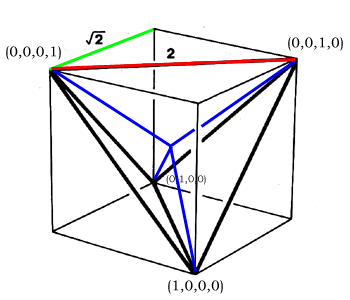
The canonical relationship I'm using puts (1,0,0,0) at the corner of a cube in the first XYZ octant, the all positives octant.  The corresponding tetrahedron has corners in octants (+,+,+), (-,-,+), (-,+,-) and (+,-,-).

Picture two line segments, one above the XY plane, the other below it, at 90 degrees to one another (but not intersecting).  Either edge may be considered a "spine" with "wings tips" at the other edge's end points.

See Figure:
The cube is upside down i.e. the XYZ positive octant is where we would usually put (1,0,0,0)). Quadrays are shown in blue.

However the size of this cube is "all face diagonals = 2" which means the so-called "basis vectors" (four of them) are not "unit" in length.  What's more important, for a starting place, is that the edges of this canonical tetrahedron have all edges 2.  We might call this the "basis tetrahedron" (or "home base").

What is this cube of face diagonals 2 relative to in terms of sphere packing?  Think of three unit radius balls packed tightly into a triangle with a fourth ball nested on the valley these three form, on either side of the triangle.

That makes a tetrahedron of balls with edges going from ball-center to ball-center.  Each edge has length 2R (twice the radius of each ball) or D (the diameter of each ball).

Figures:
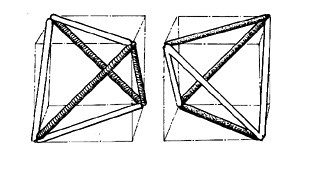
http://www.rwgrayprojects.com/synergetics/s09/figs/f86161.html
http://www.rwgrayprojects.com/synergetics/s04/figs/f1105.html

Vector Addition:

How do we add two vectors in XYZ?  Easy:  we simply sum their respective (x,y,z) coordinates.  If v0 = (x0,y0,z0) and v1 = (x1,y1,z1) then v0 + v1 = (x0+x1, y0+y1, z0+z1).

Concrete example: (1,2,3) + (-1,-2,-3) = (0,0,0).

Negating the first set of basis quadrays to get a second set, i.e. the remaining four corners of the 8-vertex cube, may be done with scalar multiplication, however the second set of quadrays defining the "inverse tetrahedron" (the dual of the first, same volume) does not need to introduce any negative numbers. 

The first set was already sufficient to map (span, address) space, so our 4-tuples are free to remain entirely non-negative in their final (reduced, normalized, canonical) expression.

- (1,0,0,0) = (-1,0,0,0) = (0,1,1,1)  (i.e. 180 degree flipped)
i.e. a vector pointing oppositely.

The four "negative" quadrays, pointing at 180 degree to the first four would then be:

{(0,1,1,1),(1,0,1,1),(1,1,0,1),(1,1,1,0)}.

The two sets together define the eight vertexes of a cube.

Note the four pairs of inverse vectors always sum to the identity vector e.

(1,0,0,0) + (0,1,1,1) = (1,1,1,1) = (0,0,0,0) = e

(0,1,0,0) + (1,0,1,1) = (1,1,1,1) = (0,0,0,0) = e

and so on.  XYZ is the same way:  v + (-v) = e = (0,0,0).

We see that the operation of vector addition with quadrays involves a two step algorithm:

Step 1: add corresponding elements in each 4-tuple, then

Step 2: normalize to the canonical representation using an identity bringing the minimum element (which may be a negative number) to zero. 

Subtracting two quadrays is syntactic sugar for adding the inverse i.e. q0 - q1 = q0 + (-q1).  A negated quadray may always be expressed in canonical (non-negative element) form.

Example:

(1,1,2,0) - (3,1,1,0) = (1,1,2,0) + (-3, -1, -1, 0) = (-2, 0, 1, 0) = (-2, 0, 1, 0) + (2,2,2,2) = (0, 2, 3, 2)

We might also do it this way: (1,1,2,0) - (3,1,1,0) = (1,1,2,0) + (0, 2, 2, 3) = (1, 3, 4, 3) = (0, 2, 3, 2)

Note that (1,3,4,3) is not canonical form either, as we still need to apply Step 2:  subtract the minimum element from all four i.e. (1,3,4,3) - (1,1,1,1) = (0,2,3,2).

We're done when one or more elements is 0 and the others are non-negative.

A secondary canonical form, used interimly in some algorithms, allows negative numbers but requires the four coordinates add to zero.  (2,0,1,1) becomes (1,-1,0,0) by adding (-1, -1, -1, -1).

Any (a, a, a, a) = (0, 0, 0, 0) = e because the four vectors (a,0,0,0) + (0,a,0,0) + (0,0,a,0) + (0,0,0,a) cancel one another out and sum to the origin.  

XYZ is like this too: adding all six spokes of "the jack" nets to the zero sum vector i.e. e (identity element for vector addition).

Conclusions:

What's been defined above so far is sufficient to provide:

(i) a distance formula (length formula) for any quadray vector, such that |v| -> Number were v is a quadray (this is well developed in other writings, as well as in computer code).

(ii) a conversion algorithm whereby any (x,y,z) coordinate may be expressed as a unique quadray in canonical form, and vice versa:  every quadray may be expressed in (x,y,z) coordinates (also implemented).

One property of Quadrays that's interesting then, is they're isomorphic to XYZ.

Consider that spherical coordinates (r, theta, alpha) are also a useful expression of all the same points  addressed by (x,y,z).  Isomorphism is a feature, not an unnecessary redundancy.  Sometimes computing in an alternative representation is more convenient and/or generative of new insights.

Quadray coordinates, like spherical coordinates, give another unique address for the same point in space. They could be introduced in conjunction with spherical coordinates as an alternative representation.

Another property of quadrays is their ability to sum, using only positive integer 4-tuples, to give the vertexes needed for a canonical set of concentric polyhedrons, starting with the basis tetrahedron of edges 2R and volume one.

Volume one?  That's not conventional in XYZ thinking either, but we have a logical foundation for using this alternative model, with a triangular analog. The implications of this alternative logic are worth exploring.

If we adopt the unit-tet model then we likewise get whole number volumes for (volumes in parens):
  • the canonical quadray cube described above (3) 
  • its dual octahedron where edges cross (4) 
  • their combination as a rhombic dodecahedron (6) and 
  • the 12-balls-around-1 cuboctahedron that characterizes any ball in the CCP lattice (20). 

For example the corners of the latter cuboctahedron are simply the 12 points:

{(2, 1, 1, 0), (2, 1, 0, 1), (2, 1, 1, 0), (2, 1, 0, 1), (2, 0, 1, 1), (2, 0, 1, 1),
 (1, 2, 1, 0), (1, 2, 0, 1), (1, 1, 2, 0), (1, 1, 0, 2), (1, 0, 2, 1), (1, 0, 1, 2),
 (1, 2, 1, 0), (1, 2, 0, 1), (1, 1, 2, 0), (1, 1, 0, 2), (1, 0, 2, 1), (1, 0, 1, 2),
 (0, 2, 1, 1), (0, 2, 1, 1), (0, 1, 2, 1), (0, 1, 1, 2), (0, 1, 2, 1), (0, 1, 1, 2)}

i.e. all combinations of {2,1,1,0}. 

Restricting quadray addition to a pool of only these, disallowing any scaling, gives the vertexes of the CPP (= FCC), the dense-packing (~74% ) of unit-radius balls, a "home base" in crystallography.

Also true, though not proved here:  any tetrahedron defined by four CCP vertexes has a whole number volume relative to our canonical reference tetrahedron of volume one.

For further reading:
The Quadray Papers
Posting to mathfuture (April 25, 2016)

Sunday, April 17, 2016

Nonsense Numbers

:: divergent numbers ::

When I visited the Earlham College campus in Indiana some months ago, I was privileged to address the Philosophy Club, somewhat extra-curricular yet affiliated with the philosophy department.  I briefly went over a discussion we'd been having on math-teach (The Math Forum / Drexel) regarding the following:

We all know about Cantor's work showing N and R belong to different orders of infinity.  We can make elements of N (1,2,3...) pair with all the rationals Q by a well defined process, but we can show that no plodding method forward will map all of R with members of N.

But is N itself "numerable" in the Cantorian sense?  Consider what I call "mirror pi" which is just the digits of pi-to-the right "reflected in the mirror"

3.14159... -> ...951413

The 3-dots (...) signify that the digits go on forever per known algorithms, in both cases.  On the left, we say we're converging to some R.  On the right, I'd say we're "diverging" to a specific element in N, which likewise has infinite digits. 

What it takes to be "specific" is simply an algorithm.  The notion of "convergence" as getting smaller and smaller (closer and closer) is distinct from the concept of "specificity".  Think of serial numbers without ordering (no > or <, only == and !=).

Or we could simply write pi like this:  314159... with the understanding that we'll never make use of a decimal point.  We'll just keep writing a longer and longer string of numbers.

One may imagine some quantity getting bigger and bigger, but think of it instead as writing the unique (but infinite) serial number for some grain of sand on the beach, a member of R (right?), and in this case also a member of N (a positive integer).

I think you'll find a lot of die-hards wanna keep numbers like 314159... out of N, because leaving them in messes with N and R having different Aleph numbers.

We also want to keep the idea of "unique infinity" in some way i.e. if all these "infinite serial numbers" are both truly infinitely big (the reciprocal of infinitely small) and yet are each "specific to one element in the set R" (true in case of pi in R, but argued about. with respect to mirror-pi).

In that case, if each is unique, then may we write:  314159.... (pi's digits) > 161803... (phi's digits)?  What about 999123... > 55555... > 1239... ?  Some will say this expression is meaningless, because these are meaningless strings masquerading as signifying numbers.

Would making the rule for extending them help at all?

The use of the inequality sign above violates our sense of a "unique infinity" (or do we have that sense?).  The idea that 999... (always 9s) has a "permanent head start in its most significant digit" over 333...  (always 3s) seems more of an argument that < and > should go away with "numbers" written like this.

Ordering is not defined, merely equality and inequality?  If that's accepted, then these are not members of N as N has a well-defined notion of ordering right?  There's never doubt about which element is greater, given two elements.  Is that so by theorem or by axiom I wonder?

I propose we name this "set of infinite serial numbers" (which have many properties in common with members of N) the "nonsense numbers" which "diverge to a unique significand" (that object which the number symbolizes -- we're taught to think some name->object model applies when it comes to ordinary infinitely digits pi in any case, a standard part of the mental baggage).

It will be difficult to distinguish Nonsense Numbers from actual members of N however i.e. how would we know for sure, if these are actually distinct sets.  In which set should we put 22222.... (always 2). 

Given N is defined to be infinite, it follows that it *must* have room for such numbers with an infinite number of digits (if not, N is finite, a contradiction), so that really argues for the Nonsense Numbers being a subset of N. 

Perhaps that's how we should teach them then? 

"N is for Nonsense Numbers" (otherwise known as Natural Numbers,only some of which have finite digits).

[first draft posted to mathfuture earlier same day]

For further reading:

Tuesday, March 29, 2016

Base Camp Meets Coffee Shop

I find it both anomalous and fitting that my "math is an outdoor sport" scouting meme, and my Coffee Shops Network meme, are floating together.

The scouting meme connects to the more discipline experience of life on base, training, a boot camp, with the coffee shop a place to relax and unwind, off base, a safe retreat.

The two institutions balance one another.  Student union.  Back stage (off script).

The reveries on the LCDs help with studying, with some reveries doubling as thinly veiled PR for whatever superstar course.  Come to space camp or whatever.  Remember we have winner philanthropists in the room.  Even if they don't sign up themselves, they might sponsor.

If you're looking for opportunities, just watching these screens will give you ideas sometimes.

However there's no need to be too impulsive.

A good boot camp is surrounded with a gradient, different levels of commitment.  Help students feel their way forward.  Road maps:  also a good idea.  Take the Introduction to Programming course, find out which "full stack" or "tool chain" might best fit your dreams.

I'm using "code school" and "boot camp" almost interchangeably, but then injecting more from the cooking and camping arenas, more farming.  The Internet of Things does not always mean tiny things.

Cooking in an industrial kitchen teaches about concurrency (kept promises trigger what to do next), as does theater whereas coding for exceptions handles promises not kept.  Things happen.

As I was mentioning on mathfuture earlier this morning, we want a Tractor class in part because we may be using a real tractor later that same day, or in a next work/study stint.

Software engineering, sensors, tracking inventory, weighing costs (trade-offs):  this is systems analysis and agile, all rolled into one.

Wednesday, January 6, 2016

World Game Meetup

I joined a bunch of Meetups on Meetup.com to ring in the new year, and in so doing found out about the Portland World Game meetup.

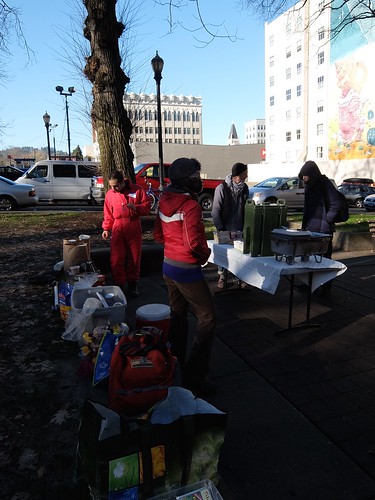
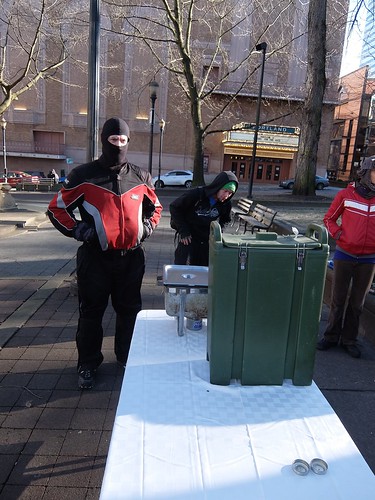
The group was staging a "positive protest" (not against anything) that very day, New Year's Day, in the South Park blocks.

World Game Meetup

I was on a tight schedule so only managed a few shots during the setup phase.  I got into a conversation with a guy, only four months in Portland, about how prolific Fuller was (the genius behind the World Game meme).  Operating Manual for Spaceship Earth was one of his more influential titles.

Setting Up

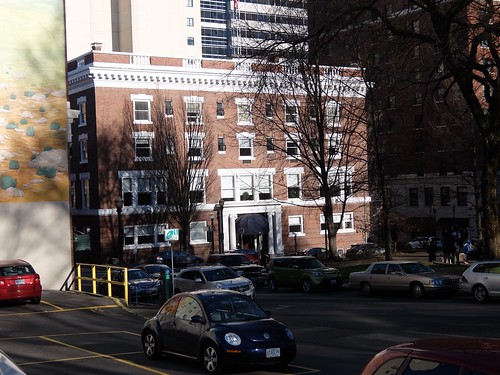
I pointed to the nearby Arlington Club as where Ed and June Applewhite had stayed, when visiting Portland in the 1990s.  Ed was Fuller's chief collaborator on the two Synergetics volumes.  He wrote Cosmic Fishing to chronicle that experience.

Arlington Club

Thursday, December 31, 2015

Nomadic Villages

How does CSN inter-operate with the "nomadic village" initiative?  Remember the purpose of CSN:  to provide opportunities for philanthropic investments.

Companies allow their customers to rise towards stardom as players in various computer games that pay out to board-approved worthy causes.

Profit-sharing includes building an asset called Good Will in traditional economics textbooks.  How this gets done is an evolving process, affected by innovations in software and hardware.

Donations to charitable causes adds to a company's PR.  Corporate persons express their values through their patterns of funding, a form of image-making.

Valving donations through micro-investments made by customers, as facilitated by the Coffee Shops Network, makes for a more open environment, as players share their profiles and portfolios.

Nomadic villages are designed with a TTL (time to live) in any given site, after which they fold up their tents (figuratively speaking, though some do use actual tents) and move on.

Some villages maintain their identity when they move, while others fork and branch.

The thinking behind the architecture is different when a village is designed from the ground up to be nomadic.  How small a footprint is left behind?  What traces are left?

What goes into making a village mobile?  The idea of a caravan, gypsy wagons, hippie buses, suggests a "traveling road show".  What goes by shipping container.  Do helicopters have a role?

Another model is more "World's Fair" in that usable infrastructure is left behind by intent.  Landscaping.  An airstrip and/or helipad.  A next village will occupy the same digs, but with different gear.

A typical mindset when it comes to "new settlements" is open-ended longevity, whereby structures get built with no plan for their eventual demolition and/or removal.  The "nomadic village", in contrast, is at a location on a schedule, with start and end times.

When villages are choreographed to move around, like cruise ships, but with less cohesion, the technology becomes more agile.  Weight and structural integrity matter more.

As a matter of logic, refugee camps would be among the first in line to test prototypes.